A First Read of an International Agreement
A first read of an international agreement is clearer when you map its layout, trace article links, and record what each clause asks a party to do.
The common mistake in a first read of an international agreement is to treat one memorable sentence as the whole deal. That can leave out the article that explains how the document operates, who must act, or what process applies. A first read of an international agreement is more useful when you map its layout and connections before interpreting a clause.
Map the document before interpreting its articles
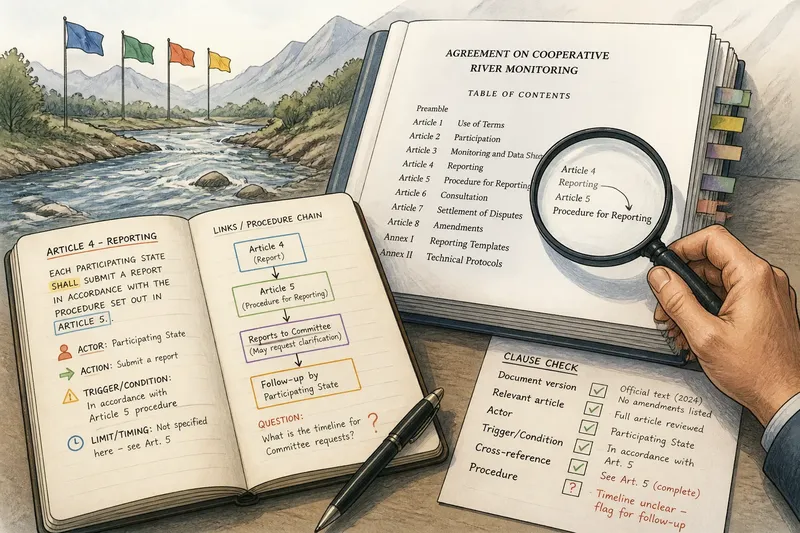
Start by checking the contents page, article headings, and any annexes or protocols listed with the text. Make a simple map of where the agreement places its main subjects: participation, implementation, reporting, dispute procedures, and changes to the instrument. The aim is not to summarize every section; it is to know where to look when a clause points elsewhere.
Use the official source where available, such as a government treaty database or the depositary’s website. Confirm that the copy includes the full text and note any listed amendments, protocols, or annexes. A news story or an excerpt may quote a clause without showing the surrounding material that gives it context.
Write down the agreement’s title and the date or version shown on the source page. If the page is unclear about whether later documents apply, mark that as a question rather than assuming the text is current or complete.
Turn each operative sentence into a reading note
Once you have the document map, choose the article relevant to your question and read the whole article. For each operative sentence, note four things: the actor, the action, the condition that triggers it, and any stated limit or timing. Keep the note beside the original wording so that a plain-language paraphrase does not quietly broaden the rule.
Pay attention to the verbs. “Shall” commonly signals an obligation in treaty drafting, while “may” commonly gives permission or discretion; context and the instrument’s own wording still matter. Terms such as “subject to,” “unless,” and “in accordance with” often send you to a condition or process that must be read too.
Use a PDF search function to find article numbers and repeated phrases. A paper copy and pencil work just as well: mark the cross-reference, turn to the cited provision, then return and reread the original sentence with that material in view.
Trace procedural links instead of reading clauses alone
Some provisions establish the route for carrying out the agreement rather than describing its central policy. They may explain how parties submit information, consult one another, raise a dispute, or propose a change. These procedures can determine what a party is expected to do next, so record the sequence rather than relying on a single quoted line.
Follow each explicit cross-reference to its destination and check whether it points to a definition, a deadline, a decision-making body, or another procedure. If the destination refers onward, continue until the chain ends. Then return to the starting clause and ask whether the linked material changes the action, timing, or available options.
Say you are reading an invented agreement on shared river monitoring. An article says each participating state submits a report under the procedure in another article. You follow that link and find that the procedure calls for reports to go to a named committee, which may request clarification. Your note would record the reporting actor, recipient, and follow-up route; it would not claim that the committee has powers the text does not give it.
Use a clause check to decide what needs another look
- Document version: Check whether the source identifies the full agreement and any amendments; if it does, use that version, then note unresolved version questions, but if it does not, find an official complete copy before relying on the clause.
- Relevant article: Check the entire article, including its heading and surrounding sentences; if those sentences clarify the action, include the clarification in your note, but if the excerpt omits them, retrieve the full article.
- Actor: Check who the sentence names as responsible; if it names a party or designated body, record that actor, but if the actor is unclear, mark the ambiguity instead of assigning responsibility by guesswork.
- Trigger: Check for words such as “if,” “when,” or “subject to”; if a condition is stated, include it in your reading note, but if its meaning is uncertain, follow the relevant reference and flag what remains unclear.
- Cross-reference: Check every cited article, annex, or procedure; if it adds a step or limit, revise your note to include it, but if the destination is missing from your copy, locate the complete instrument.
- Procedure: Check whether the clause identifies a recipient, process, or next action; if it does, record the sequence, but if the sequence cannot be completed from the text at hand, mark the missing link for follow-up.
Which parts of an agreement should you check first?
How do you find the procedure an article refers to?
Search the cited article number in the full text, then read its complete provision and any further links it contains. Return to the first article and update your note with the procedure’s relevant action, actor, and condition.
What does “shall” mean in an agreement?
It commonly marks an obligation, but the sentence’s subject, conditions, and surrounding provisions determine what the obligation requires. Read the whole clause and follow any references before paraphrasing it.
What should you do if a clause is unclear?
Mark the exact phrase and collect the nearby provisions that may clarify it. If the uncertainty matters to a legal decision, consult a qualified professional familiar with the agreement and applicable law.
Can an excerpt answer a question about an agreement?
An excerpt can help locate a relevant provision, but it may omit qualifications, linked procedures, or later changes. Check the complete official text and its associated documents before relying on the passage.
Keep a record that supports a careful second read
For each relevant article, keep the article number, a short note on actor and action, the trigger or limit, and links to any related provisions. Add a separate question wherever the wording leaves a gap. This gives you a focused route back into the agreement without turning your notes into a substitute for its text.
Use the phrase “first read of an international agreement” as a reminder to map the document, trace its procedural links, and preserve uncertainty where the text does not settle an issue. For decisions with legal consequences, rely on the official instrument and seek qualified advice when needed; the most useful reading note makes clear both what the text says and what still needs checking.