Treaty, Declaration or Memorandum: What Changes Between Them?
Compare a treaty, declaration, and memorandum by their purpose and likely role, so you can describe what each document does without relying on its label.

The most common mistake when comparing a treaty, declaration, or memorandum is to assume its title tells you what the parties have promised. That can leave you with a mistaken account of the agreement’s purpose and commitments. A treaty may establish obligations, a declaration may state shared principles, and a memorandum may organize cooperation, but the label alone does not settle the effect.
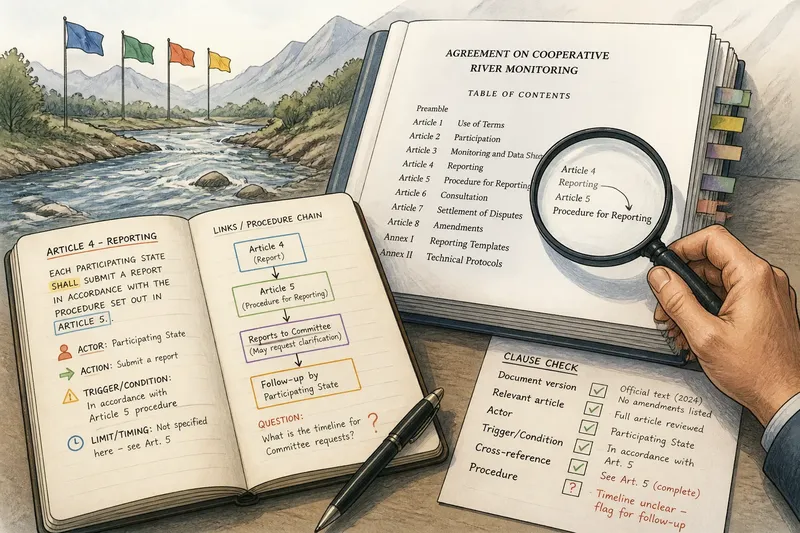
Instead, compare the documents by the job each one is intended to do. Read the operative clauses, which set out what the parties agree to do, and note how the text describes consent, implementation, and review. These details help distinguish a legal framework from a political statement or a plan for practical cooperation.
Compare the purpose of each document
A treaty is commonly used for an agreement intended to create obligations under international law. Its provisions may establish duties, rights, procedures, or shared rules. The parties’ consent and the terms they adopt matter; the word “treaty” on a cover does not explain the full scope or process.
A declaration often expresses principles, intentions, or a shared political position. Some declarations state standards or priorities without setting out a treaty-style system of obligations. Others may connect to a binding legal framework or carry legal significance because of their wording and context.
A memorandum of understanding, often called an MOU, commonly records an arrangement for cooperation. It may describe shared objectives, responsibilities, meetings, information exchange, or a work plan. Some memoranda are intended to be nonbinding; others may contain provisions the parties intend to have legal effect.
Do not rank these forms as a fixed ladder from strongest to weakest. A treaty may establish a legal framework, a declaration may state a position, and an MOU may organize joint work. Those are common functions, not conclusions about a particular text.
Look at commitments without treating verbs as a legal test
Underline the verbs in the operative clauses. “Shall” or “must” can signal a firm obligation, while “should,” “intend to,” or “endeavor to” may leave more room for discretion. These words are clues, not an automatic legal test. Read the whole clause, including defined terms and conditions.
Compare what the sentence asks the parties to do. “The parties shall exchange information” assigns an action. “The parties recognize the importance of exchanging information” records a position but does not necessarily require a particular exchange. “The parties intend to establish a working group” describes a plan whose force depends on the rest of the text.
Note limits that narrow a commitment. A clause may apply only to certain topics, territories, agencies, or circumstances. It may make action subject to domestic law, available resources, or later approval. Keep those qualifications in any description of what the parties have agreed to do.
Distinguish legal force from political and practical influence
Legal force and political importance are different questions. A nonbinding declaration can carry political weight because parties publicly endorse its principles. An MOU can organize ongoing cooperation without establishing enforceable legal duties. A treaty can create legal commitments while leaving choices about domestic implementation.
Write two separate notes for each document. In one, describe the legal position the text appears to establish, using cautious language if it is unclear. In the other, describe the political or practical signal: what the parties publicly support, coordinate, or intend to pursue.
Look for mechanisms such as monitoring, meetings, reporting, consultation, or dispute handling. They may help parties track progress or address disagreements. Their presence alone does not establish that every substantive clause is legally binding, and their absence does not mean the document has no practical influence.
Check how the parties plan to put the agreement into practice
Some agreements call for further action, such as domestic legislation, administrative procedures, funding decisions, or a later arrangement. Others assign tasks to agencies, create a joint committee, or invite the parties to prepare a work plan. These provisions show how an international commitment is expected to connect with institutions and decisions.
Read any clauses on approval, entry into force, amendment, or withdrawal. A document may take effect after an event, such as an exchange of notifications, or only for parties that complete a specified approval process. Do not infer that it has taken effect simply because it was signed or announced.
Say you find an MOU between two governments that says they “intend to cooperate” on sharing environmental data and calls for officials to meet, but does not state when it takes effect or establish an explicit legal obligation. You could describe it as a plan for cooperation and note the meetings it calls for. You would avoid claiming that data sharing is legally required based on the text provided.
Use a comparison checklist to describe what the text supports
For each document, record what you can point to in its text. If the document does not address a topic, write “not specified” rather than filling the gap with an assumption.
- Purpose: If the text sets shared rules, describe its rule-setting role; if it states principles, describe the stated position; if it organizes joint work, describe the cooperation plan.
- Commitments: If a clause assigns an action, name the action and responsible party; if it only expresses support or intent, describe that language without turning it into a firm duty.
- Conditions: If a clause limits action by topic, territory, agency, or circumstance, include that limit; if no such limit appears, do not invent one.
- Consent and effect: If the text requires approval or another formal act, note that process; if it does not say how it takes effect, mark the point as unspecified.
- Implementation: If the text assigns work to an agency or committee, name the task; if it names no implementing body, do not imply that one exists.
- Review and change: If the text describes monitoring, amendment, withdrawal, or dispute procedures, record them; if it is silent, say the procedure is not specified.
Imagine you are comparing a declaration that states support for environmental cooperation with an MOU that calls for officials to exchange data and meet. Start by recording the declaration’s stated principle and the MOU’s named actions. Then check whether either text assigns a binding duty, sets conditions, or describes approval and implementation. If the declaration states no specific action and the MOU uses intent language without an explicit obligation, your comparison should call the first a statement of support and the second a cooperation plan—not claim that either requires data sharing.
What questions help distinguish a treaty, declaration, and memorandum?
Does the title determine whether an agreement is binding?
No. The title is a clue to common purpose, but the wording, context, and consent process matter. Check the actual provisions before describing legal effect.
Can a declaration have legal significance?
It can, depending on its wording and relationship to other instruments. Some declarations state political principles, while others form part of a broader legal arrangement.
Can an MOU create legal obligations?
Some memoranda are intended to be nonbinding, while others may include provisions intended to have legal effect. Read the clauses and relevant context rather than relying on “memorandum” as the answer.
What should I do if the text leaves its effect unclear?
Check the official text and related instruments, such as a protocol, exchange of notes, implementing arrangement, or later amendment. For a question about legal obligations or a dispute over interpretation, consult an authoritative legal source or a qualified international-law professional.
Describe the agreement without overstating its effect
Begin with the document’s stated purpose, then identify its clearest commitments and how the parties plan to carry them out. Separate what the text expressly says from what you infer. “The MOU sets out a plan for agency cooperation” is more precise than “The MOU legally requires cooperation” unless the provisions support that stronger claim.
A treaty, declaration, or memorandum is best understood through the work it does and the commitments its text supports. When asked whether it is binding, point to the relevant clauses and consent process. If those details leave the answer uncertain, state the uncertainty instead of letting the title fill the gap.