Before the Charter: Why the League of Nations Was Created
Why was the League of Nations created? Learn how its postwar purpose shaped its institutions and why member states retained control over collective action.
The most common mistake in explaining why the League of Nations was created is to treat it as a world government that simply failed to enforce its laws. The distinction matters: the League offered member states a continuing forum to address disputes, but governments retained control over their own policies and armed forces.
The League was created to make diplomacy continuous
After the First World War, the League’s founders sought a standing process for discussing disputes and organizing a collective response. They hoped that consultation, public commitments and shared pressure could help prevent a local confrontation from widening into another general war.
Before the League, governments relied heavily on bilateral diplomacy, shifting alliances and conferences convened for particular crises. Those methods remained available, but the League added a continuing forum where members were expected to consult one another.
The aim was not to eliminate disagreement. It was to give governments a reason and an opportunity to pause, negotiate or accept inquiry before turning to force. A state’s conduct would become a matter for discussion among other members rather than only a private dispute with its immediate opponent.
The Covenant established institutions and procedures
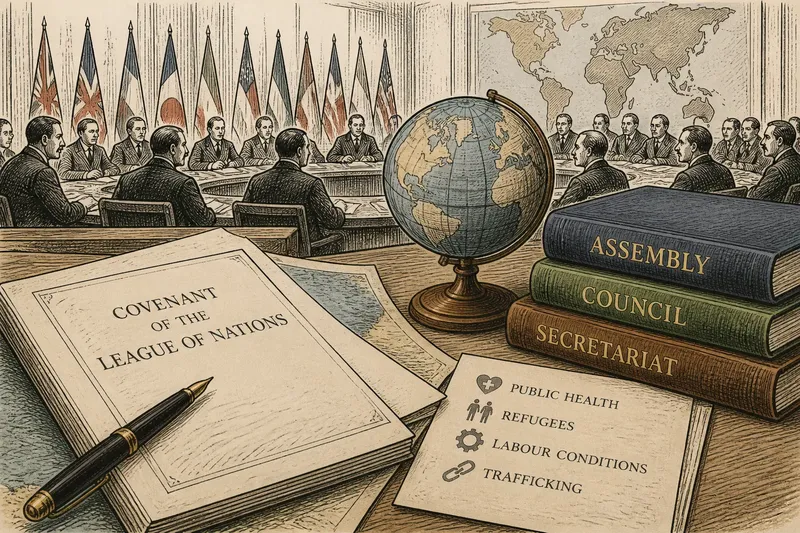
The League’s Covenant set out its purposes and procedures. The Assembly provided a forum for member states to discuss common concerns. The Council considered urgent political questions and disputes. A Secretariat supported their work by maintaining records, preparing meetings and providing continuity.
The League also supported cooperation on practical cross-border concerns, including public health, refugees, labor conditions and trafficking. That work differed from responding to aggression: it often involved sharing information and coordinating administration rather than confronting a state over its conduct.
Membership was not universal. The United States did not join because the Senate did not approve the postwar treaty arrangement that would have brought it in. Other countries joined, left or were excluded at different points, so the League’s membership and influence changed over time.
Collective security depended on member decisions
Collective security meant that aggression against one state should concern the membership as a whole. The League could consider a dispute, identify a breach of its rules and recommend measures such as diplomatic or economic pressure.
Those recommendations were not automatic commands. The League had no standing army and could not require national governments to provide troops or adopt every proposed sanction. Members retained authority over their armed forces, trade and foreign policy, so each government had to decide what action it was willing to take.
This arrangement made the League possible without transferring control of war and peace to an international body. It also meant that a common response could falter if governments disagreed about its purpose, risks or cost.
Decision rules varied by body and question
It is too broad to say that every League decision required unanimity. The Covenant set different procedures for different bodies and matters. In the Assembly and Council, unanimity was generally required for decisions outside specified exceptions, while procedural questions and particular categories of business were treated differently.
The rule was intended to protect members from being overruled on important questions. In practice, the need for broad agreement could make a response slower or harder to reach. Its effect depended on which body was acting, what question it considered and which Covenant provision applied.
Even when members reached a decision, implementation still rested largely with governments. The League could organize discussion and recommend a response, but it did not have independent means to make states carry it out.
The League’s authority had clear limits
The League relied on its members to turn shared judgments into consequences. If a government chose to defy its commitments, other members had to decide whether to coordinate pressure and accept the consequences of doing so. The institution’s influence was strongest when members were willing to act together.
The League therefore did not replace national decision-making. It created procedures for consultation and cooperation, while leaving governments with the authority to accept, delay or refuse proposed action. This single design limit explains why its rules could set expectations without ensuring a common response.
The United States stayed outside the League
President Woodrow Wilson supported the idea of a permanent international organization, but the United States did not become a member. The Senate did not approve the treaty arrangement that would have brought the country into the League, reflecting domestic political disagreement over participation.
The absence limited the League’s reach and the weight its members could bring to collective action. It also showed that international commitments depend on domestic approval: a president’s support for an institution does not itself secure a country’s membership.
The League’s practical cooperation was distinct from security
The League did not prevent the Second World War. Yet its work on refugees, health, labor and trafficking showed how an international organization could coordinate ongoing responses to shared problems. These efforts did not require the same kind of confrontation as collective security, which helps explain why practical cooperation could continue even when the League’s political authority weakened.
Imagine a member state asks the League to address a dispute with a neighbor. The League convenes a discussion, seeks a settlement and recommends diplomatic or trade pressure. If other members decide not to adopt those measures, the request produces discussion but no coordinated pressure; if they agree to act, each government still has to carry out its own part. This invented situation shows the difference between a forum that organizes judgment and a government that controls implementation.
How does the League’s design compare with the United Nations?
What did the United Nations retain from the League?
The United Nations, established after the Second World War, retained a general assembly and a secretariat. It also gave a smaller Security Council a central role in questions of international peace and security.
How did the later system account for major powers?
The United Nations’ framework gave major powers a distinct role in the Security Council rather than treating all states as having identical influence in every security decision. That design recognized the political weight of powerful states while creating procedures for collective action.
Did the United Nations remove the League’s central limitation?
No international organization can make governments supply political support or resources simply by declaring a shared purpose. The League’s history remains useful because it clarifies the difference between agreeing that peace is a common responsibility and agreeing on who will bear the costs of responding.
Why was the League of Nations created?
The League of Nations was created to make consultation a regular part of international relations and to give governments a process for addressing disputes before they escalated. Its institutions also provided channels for cooperation on practical cross-border problems.
To understand why the League of Nations was created, look at both its purpose and its limits: it gave states a shared forum, but left them in control of whether to carry out collective action. That distinction is useful when assessing what any international institution can do—and what still depends on its members.